Thursday, 1 March 2012

Making a Show about Carol Grimes with Carol Grimes


Convener: Sophie Trott

Summary of discussion, conclusions and/or recommendations:

I had to go home with my 2 year old before this session, but I had some useful conversations with a guy called Nicholas, who had written a biographical piece recently, and Jenifer Toksvig.
Carol Grimes, a singer has written a book about her life, and wants to make a show which is part gig, part story.  She wants to do the singing, and not play herself. I expect this will start life as a gig with me reading bits of her book between the songs.  But I’m wondering how to grow it beyond that.
Nicholas talked about the need to find a pivotal moment to act as a sort of prism which then refracts light onto different bits of the story. He put it elegantly, not how it is here.  He also suggested watching Hedwig and the Angry Inch as an example of how to structure a biographical piece.
Jen offered to have more chats when I didn’t have a restless child who needs a sleep.
Useful.

Let’s Have A Creche


Convener: Sophie Trott

Summary of discussion, conclusions and/or recommendations:

I wasn’t able to stay for my session because I needed to take a very tired child home.  But I did have a few chats with various other people about this, some parents, some not.  And I’ve had some ideas.

I understand that from a legal point of view, it is tricky for Improbable to provide a crèche or even talk about provision for one from an outside group.

There were a number of informal arrangements, which worked for those people who were already friends.  However, those who don’t have other friends with kids are excluded from this.

What if I set up a facebook group for people with children wanting to come to D&D?  It could post on the D&D facebook (group? Page?) without having come from the organisers of the event.  People would then be able to say to each other how many children they needed to bring and make all sorts of reciprocal arrangements.

For example I could say something like:  I’m bringing my 2 year old, and would be happy to mind another child for a session if someone’ll do the same for me. 

That’s what I’ll do then.  Will try and call it kidsatD&D or something. 

Another thought about the geography of the room is that I noticed when I was hanging out with my daughter and her friend, they were really happy to be in the middle of things, and this didn’t seem to bother anyone.  Maybe once the opening circle has happened some toys and drawing stuff could be in the middle of the room as well as in the little ‘fenced off’ area.

Wednesday, 29 February 2012

Issues called but not yet reported


At least Tesco pay expenses. Is there too many unpaid jobs/internships in Theatre

Want to go for a walk? Meet outside at 16:30

Free space exchange: any ideas? Skills-swaps dead space

What are greener non toxic making techniques for puppet and prop makers

Hello, my name is Sarah. I’m developing a new opera that aims to find ways for deaf & hearing-impaired people to engage with sound/music. If you’re interested in talking/involving yourself/giving advice please find me – purple legs, stripy jumper, red bag, curly hair…

How can we trust arts organizations wanting to support independent artists/inventors?

The Feldenkrais Method and Performance and Life in general

Should the Arts Council Funding East to Edinburgh scheme be left alone, opened up to the rest of us, or scrapped?

D&D Roadshow 2012

“It’s only a show” – how to be still devoted, not indifferent, but not care so much?

Massage my shoulders and I’ll massage your ego (ps I have access to funding)

Massage my shoulders (& neck) & I’ll massage your ego even more than that other woman

Want to go for a walk?

I cured myself of 3 things this week using acupressure points. Want to learn which ones?

What unexpected partnerships can we dream up?

Are we all middle class now? Why aren’t we talking about class?

I think you can do this better than me -  I am looking for a producer to work with. I can pay cash.

Theatre-makers: how do we make a film?

The blurry line of social and work relationships.  How to still communicate as professionally and honestly as you should.

We can all do lots of things.  Why do you do what you do?

The 7 year show

Passion – so what’s all the big idea about it?

Do you produce independently? Let’s talk about processes and challenges over a cup of tea.

Is anyone else in this room curious about theatre and religion?

Science and arts crossover events – calling theatre practitioners, musicians, poets, playwrights, directors, visual artists – anybody who is interested in collaborating with scientists or responding to an academic theme, eg memory, space, time.  Event at this years Secret Garden Party.

If I call my thing a play, will more people come?

A festival on nothing

After 2012 – can we keep the culture up?

Recording live performance – what’s the value?

Non-pro musicians as musicians. Can we? How?

Does whether my show makes a profit depend on if Lyn Gardner likes it?

How do you get started after graduating from a non-traditional drama school?

Is D and D a real community or a trade fair?


Convener: Phelim McDermott

Summary of discussion, conclusions and/or recommendations:

Report Context: So first off my notes got thrown away in the clear up. I have decided to not interpret that as any kind of indication regarding the session question! What this means is it would be great if people contributed to the report by adding comments of what they said and also say who else was there!   

So this report is a very incomplete, subjective recalling of a few of the areas the conversation went and covered and a few of my own conclusions and thoughts as someone whose been running DandD with Improbable over the years.   

I called the session for a number of reasons the first was some pub feedback. This was a few people telling me that compared to previous years the event had seemed to them a little frustrating. This was because it was being treated by some as a more superficial networking event and the conversations were not getting the opportunity to go deeper or as deep as they would have liked.  

Another reason was that despite “Whoever comes are the right people” I felt the room to not have as much age diversity as previously and missed the people who had both the wisdom of "eldership" and also the grit and forthrightness of experience. Those people who were not afraid to say the unsayable and stir things up a bit. I'd spoken with Alan Cox and he'd communicated that he almost didn't come and it was only when he was nudged by me tweeting something personal to him did it tip it into him deciding to come. Because of the potential feeling of "I've had those conversations' means that one wonders whats the reason for coming might still be.  We recognised that if you keep coming back to DandD that this changed your role from someone who comes “to get stuff” or even “to give stuff” but into an elder whose presence does change the atmosphere of the space and can teach people how to use OS to create a real community. The presence of these people was something we missed but we also recognised that we are also becoming those people ourselves a movement away from coming to the event to get something but into an Eldership role. Which looks after all the voices. This role is also less of an "active" presence and more of a "being" role. A role whose presence makes certain things possible.  That's how I kicked the session off. We then covered  a number of areas. People reported that one good thing was that they had enjoyed communicating with people not with their labels and designated badges. There had been a lack of people “shoulder surfing” compared to SOTA and other events. However some were well pissed off about how they hadn't managed to get to speak and that the facilitation of groups had been “poor” or selfish by some. That the groups hadn't worked on what they wanted to and they felt they couldn't control that. This was particularly difficult for those who weren't confident about speaking in large groups. There was a request for guidance and a different facilitation methodology to support those who can't speak up or who can't be heard.  Couldn't that be provided at the start?   

I said that OS wasn't a methodology itself but that any methodology could be used within it and all could be called as a session.  I thought that the group should be allowed to evolve that in an emergent way. I Feel strongly that adding stuff from the top down was not the way and that the great thing about OS was it was a process that teaches itself. If it was needed you could call a session for it. So "a group where those who don't get to speak get to speak" and are supported. We then attempted to do it in the moment and used a talking stick and pen. Different people in the group took responsibility to make sure people who wanted to speak got heard. We were sometimes not so good at it (ESpecially me) but we enjoyed working on it in the moment and it was relieving. We enjoyed learning from each other and I enjoyed the shared leadership of the session. Whilst noticing my own tendency to hog the talking pen.   

One thing mentioned was that some people just asking forthrightly for their needs was important and that clarity of intention in calling sessions was good then if you knew it WAS a session about networking then you didn't have to go if you didn't want to. There is nothing wrong with the trade fair aspect if clarity of intention and session means you don't have to go there if you don't want to.  

I also mentioned being awake about when a group has separated it's intention and knowing those who want to talk about one thing can break off and do that whilst others can go a divergent way. All these are possible but it takes people being courageous about stepping up for that and making it happen.   

I talked about one of the aspects of community is the balancing of the impulse to look after one's own needs and individual growth and journey whilst also looking after the whole group. A concentration on too much of either one of these aspects feels like it can dissipate the group. Or the possibilty to be either too selfish or subsumed. This spectrum is important for the group to be aware of.     

We talked about calling sessions where people were silent. Movement sessions and the possibility of using different methodologies which could help this community to learn from each other.  It was noted that in the "women on top" session a small number of women were able to dominate the conversation in a large group.    

We talked about different methodologies that can help useful communication like Marshall Rosenberg's non violent communication. Nancy Kline's great book “time to think” and her work of the creation intelligent thinking.   

There was a desire and a call to have conversations that really matter that aren't just information exchange but we're real connection.   

I made a decision to make one of the d and d satellites about real community and learning and sharing effective communication skills. This was an agreed action.   

I also talked about what brought the valuable community people that we had missed might be not trying to push them to come back, but telling them why they were valued because often they didn't even know. I told Jenn in the moment why I enjoyed her continued presence at d and d and we agreed telling people why we valued them there was a good thing. We fantasised about telling people why we missed them to bring them back now soon after the event rather than trying to persuade them before the next d and d. We talked about small actions that we could do to let people know why they were missed at DandD7 not to guilt trip them but to let them know of their value in the community.  
 
What is community?  In the closing circle  lot of the people talked of having had their Loneliness and isolation taken care of by this weekend. This was definitely an aspect of DandD which is important and part of it's community value and responsibility to artists.   Other's of course could disagree and I find myself returning to Peter Block's work on community and his definition of it. This is that an authentic community can hold the space for dissent. IE the measure of whether DandD can be considered if it is an authentic community is whether it can still look after the people who don't consider it to be one!   Inauthentic communities expel people who disagree with them.   

Cults don't let people leave.    

The law of two feet means we constantly have the possibility to be awake to the groups needs and our own. We can leave or make the active choice to step up or back into the conversation. whilst looking after both our own needs for safety and attending to an awareness of the needs of others. Open space is an art of invitation..  which means its OK not to come and not to turn up. That means ever, or come, and then don't come  for a few years and then come back and be still be valued as an important part of the DandD community. For me community isn't a frozen entity it's an ongoing process of mindfulness around where I sit with my own authentic needs and the groups needs. We cant sit back and just ask is it a community or not?  Then answer the question and relax. It is a conversation. We have to keep asking that question as a practice because it might be one moment and the next moment not.  Then we consider "Having said all that what do we do now?"  A lot of the people at our session seemed to be deeply interested in the community aspect of DandD and there was an agreed commitment to work on that and our literacy and effectiveness around that. We were very pleased to be having this conversation.   

Keep the space open and keep the invitation alive! 

On the value of doubt, reflection, uncertainty and not knowing (quiet people especially welcome)


Convener: Rajni Shah

Participants: Joanne Hartley, John Pinder, Emily Hodgson, Kitty Martin, Daniel Bye, Mhairi Grealis, Sarah Pinshon, Chris Goode, David Catling, Paul Whitlock, Mark Maughan, Sophie Grodin, Lucy Avery, Steve Ryan, Kath Burlinson, Chris Grady, Simon Bowes, Tassos Stevens, Paschale Straiton, Theron Schmidt, Matt Trueman, and others.


Summary of discussion

I place a lot of value on spaces for reflection and doubt - and listening. And by Sunday morning, I hadn't really found a way for those spaces to be present at D&D, so I called this session.

What I didn't do was think much about how I might actually create the kind of space I was craving within a very loud room where lots of other conversations were happening simultaneously. I'm really grateful that so many people showed up and stayed present with the discussion - and can only apologise that the idea didn't occur to me earlier, when I might have come up with some brilliant way to create a more conducive space where we didn't have to shout. Nevertheless, we talked of...


Not knowing as a process in life

"There is so much we're supposed to know"

Engage with 'not knowing' as a process of moving forward - our constant movement between spaces of knowing and not knowing and how we might allow the value of each affect the other - the value in consciously putting oneself in a space of not knowing - but also needing a clear sense of self when valuing the space of not knowing. Which can feel tricky!


Relationship to Failure

Someone pointed out that uncertainty and doubt are always present in a rehearsal or making process - so what's the big deal?

Perhaps those spaces are always present, but at some level we are hardwired to think of spaces of uncertainty as spaces of failure. What transformations occur when we continue to inhabit these spaces instead of moving through them as quickly as possible towards a resolution?

What is the relationship between placing oneself in the unknown, and listening or empathy? What if leaving my own certainties allows me to be more in the world?

Thinking about timescales (and referring back to Simon Bowes' session on "It's going to take years") - what if something that appears to fail in the short-term eventually represents a really important shift in thinking?

Long timeframes towards change.

Again, how do we allow this kind of thinking to be something a wider audience can relish?

Audiences

There's no lack of makers interested in addressing these questions - but how do we respond to these spaces as audience members?

What does it mean to create a piece of work where the audience is free to be reflective and journey into a space of not knowing? How can we avoid slow, reflective spaces being antagonising or boring to audiences? Especially within a theatre context (as opposed to live art, for example, where this is more common)

Maybe we need to think more about how a piece of work is framed/introduced, how an audience is prepared for a piece of work. Thinking through audience expectations that are set up through the medium and its traditions (different in visual arts / live art / theatre), through the space (theatre, gallery, page, browser) and how the audience move through it, and therefore also the way that time operates within that space.

It is as if we have all been lowered into an atmosphere of glass - Anne Carson


Re-educate

Someone spoke of the importance of re-educating. My notes aren't great on this bit - but I think this relates back to the idea of frames, of thinking about the wider frame of presenting a piece of work, and acknowledging the notion of re-educating within a creative thinking process. If I want to really change the way audiences watch this work, what can I do to let them know?


Slowness as Resistance

Slowness is a resistance of narrative / expectation / speed / knowledge.
Sometimes that resistance hits the wall of a fast world. Matt spoke of not being able to engage with my show, Glorious, not because of an unwillingness, but rather an inability.


Transparency and withholding

Theron noted the difference between work where artists and audiences are entering a space of not knowing, and work where the artist is in a place of knowing and the audience is entering a space of not knowing.

We talked about transparency, and the extent to which knowledge is withheld from an audience - and how this is handled.

We didn't (but I wish we had) talk about manipulation of audiences, and whether this is desirable or unattractive or inevitable.


Gentleness can be counterproductive

Simon proposed the idea that maybe we're too gentle and worried around creating these alternative spaces. Maybe as audience members we sometimes want to be faced with an obstacle we can't get around. How do we create a culture that acknowledges that audiences can feel grateful for challenge and having been pushed?

We talked again about spaces before or after a difficult performance - the space for audiences after Internal by Belgian theatre company Ontroerend Geod, for example, or the lead-in to Coney's works.


Walking

We went for a walk at dusk.

It’s gonna take years: On the virtue(s) of taking your time


Convener: Simon Bowes

Participants: Joanne Hartley; Steve Ryan; Bethany Pitts; Alex Lehman; Matt Ball; Daniel Pitt; Ros Williams; Maddy Costa: Dachel Davies; Steve Pitman (and others); Greg McLaren

Summary of discussion, conclusions and/or recommendations:

Note that the session was called to try and identify a dissatisfaction with two (seemingly pervasive) orthodoxies, the FIRST: Edinburgh-once-a-year-or-you’re-invisible; the SECOND: Scratching-it-will-make-it-better: This is what we come up with: Maybe we NEED urgency – bound up with who you have to ask for the money – gestation periods can be too long (lost-in-gestation!) – “...being okay with your shit ideas” – “we should be practicing all the time” (perhaps a painter who produces one painting a year is automatically going to be a shittier painter than one who produces ten a year) – Scratch culture often ensures that by the time an artist “…considers the work finished, everybody’s seen it…” – Can early-career / emergent artists afford to work privacy? Is there an alternative to scratch that is artist-led, rather than venue-led, fairly enclosed, invitation-only, free, not pay-what-you-can? EXAMPLE Uninvited Guests just can’t do anything quickly (Mr. Dufty and Mr. Clarke have FULL TIME JOBS) – necessitates short, infrequent working patters (presumably with plenty of time for reflection) – they might not be prolific but they maintain their profile and never look seem to look hungry – how do we find dedicated time? – TIME IS ECONOMIC – Who says audiences knows better than artists what the work should be? – Audiences notice things the artist may have overlooked, but often give artists BAD ADVICE about how to develop their work – contrast all this with EXAMPLE Song of the Goat (Poland), or other comparable European companies: length of time spent developing the work permits depth and intricacy – “What’s the life of a show?” / “2 years to make, 2 years to show” / crossing over – “‘time’ is a question of efficiency…” – “wider than one individual process” – “there is no ladder to climb” – “…we’re not footballers (only as good as our last game)|” – No! – “…We’re as interesting as our entire body of work…” – but if let’s say, the reviewer / writer sees a bad one, they might miss a show or two before they go back – WRITING ABOUT THEATRE – “…you’re as good as the last thing you did and the thing you’re going to do next…” – is it possible to write to support a work / artist in another way? – getting a little review (well-starred or not) isn’t always that helpful – “…I’m discovering that I’m a slow thinker and a slow writer…” (becoming Okay with that) – SPILL Festival salons/ dialogues / ‘stings’: commissioned writing – all pretty encouraging – cut – EXAMPLE: “…Frayn had a five year hiatus before ‘Copenhagen’…” – MONEY BUYS TIME – but fuck the money – “…you have a duty of care to the work…” (you have a duty of care to the audience) – long timeframes permit continuities, sustaining the discourse around the work (documentation, critical thinking) – “…the little commitments make up The Big One…” – if we want to slow things down, there’s a value in that…if we make the process part of the show…a long process doesn’t necessarily mean a slow process – “the luxury of time” – “…we’re working in an industry where everyone wants to be working in that industry…” – “if you’re going to do something, really fucking do it” – “…if you can do it for £300, try getting 6…” – talking about getting Lyn to see your stuff: “…be sure that you’re ready to invite me along…” – A CULTURE SHIFT of TAKING YOUR TIME – generosity towards emerging artists (or: to an emerging / developing work, even if it’s made by an old artist) – giving time to something can buy you out of that economy EXAMPLE: Simon from Rough Fiction – a permanent ensemble, by consensual agreement – free space donated by the Actor’s Centre, for six hours every Saturday – core artists working on skills, founded in an open space, leading to a deep sense of collectivity – nobody got paid – has resulted in a finished show developed over eighteen months, equivalent of nine weeks of rehearsal spread out – in some circumstances the work itself is its own reward – what else are you spending / investing in, if not time – some kind of TRIANGLE DIAGRAM, like an equation Quick = Money, Good = Time – yeah: it can’t be cheap AND good AND quick! –  you’ve got to GIVE THE PROJECT WHAT THE PROJECT ASKS OF YOU – “…long time-frames are all well and good, but you’ve got to have outcomes, and you’ve got to stand by them…” – the work asks you: what kind of artist do you want to be

A Surprise


Convenor: Tassos Stevens

Participants:
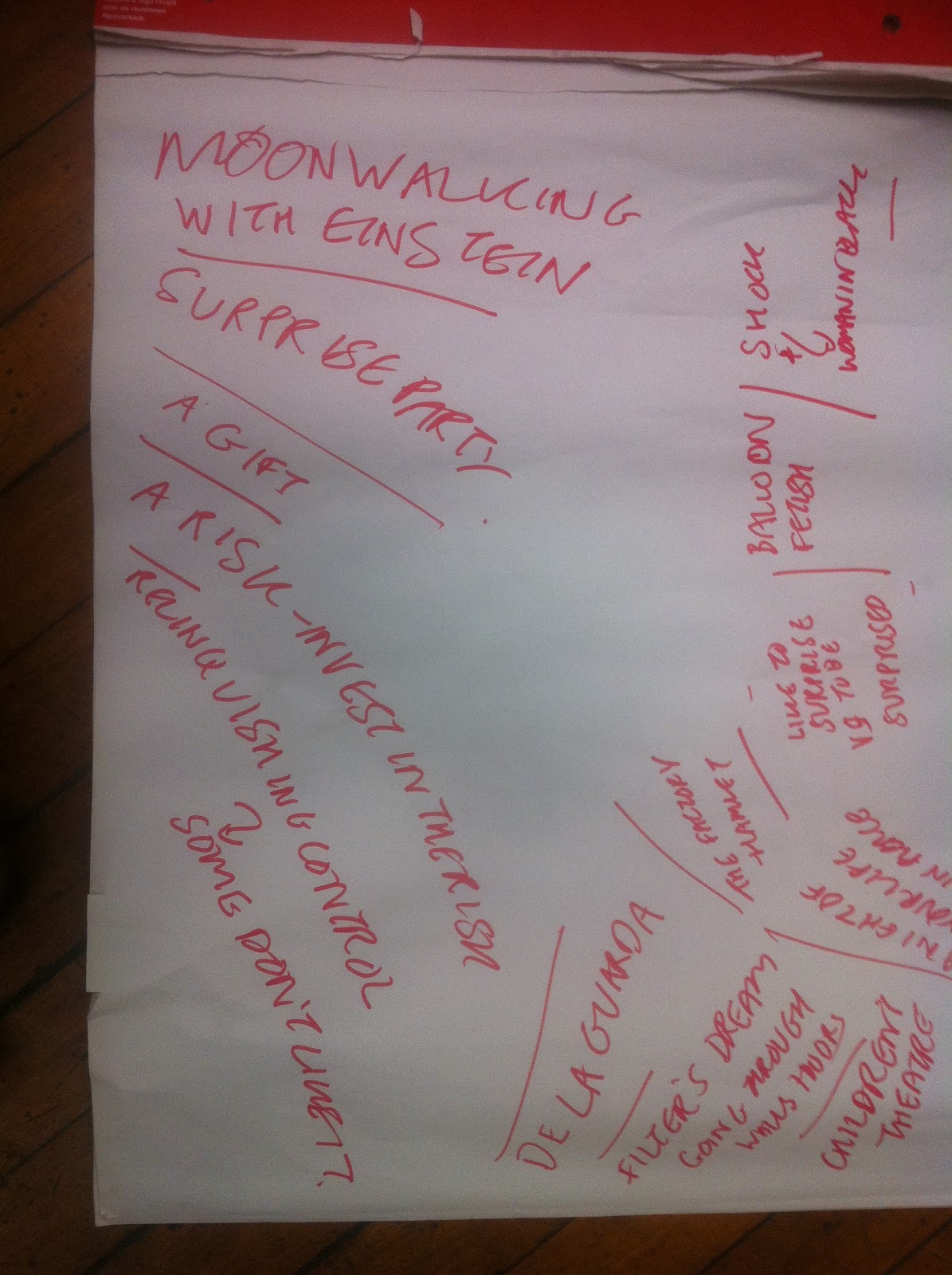
I didn't take names, but here are some photos of us during Parts 2 and 3.


What happened?
I called the session A Surprise and then deliberately placed it as late as possible in the weekend. I wanted to make an event of it and to talk about anticipation and expectations that we all have around events, especially if they are billed as A Surprise.

I took notes of what people said to me in between times to see what was going on in the collective brain of the room as to what the session might be: many people wondered if I would be surprised as well by what happened, and said it wouldn't be a surprise if I knew; someone wondered if I'd be hiding in a cake to leap out; someone wanted me to do a dance; many people just said 'exciting, don't tell me anything'.

I then managed to get surprised rather spectacularly. The session was due to start at 3pm but I managed (in the heat of a lemon joust) to lose all track of time and only noticed at 3.08pm. I saw there were various groups gathered already and was kicking myself that everyone had probably turned up excited and then left. It was only when I saw Trumpton inside the very large circle of people that I realised they were waiting for me. I was surprised, and sheepish, but maybe this was the only way it could have started.

I announced to the group that I had three parts in mind, but was open to how the group went so that I could stay surprised myself. Actually, I only had half an idea for parts 2 and 3 but was fairly confident that the right ideas would turn up in time.

In part 1, we talked about surprises in theatre, what works, what doesn't, what might be at play. I took big headline notes and took pictures of them following. In some ways though, the thing I am left with now is the insight that a surprise is a good surprise if it leaves everyone involved (especially the audience) happy to tell a good story about it. It's about a surprise present rather than a shock, where we are all invested in a delightful outcome.


About 40 minutes in, I sensed that we might start flagging so I offered part 2 or to continue with part 1. Everyone wanted part 2. So I asked everyone if they liked to follow me out of York Hall. This was the only part I'd planned. I was surprised by how our departure itself became an event to everyone else in the room, and some people got up and joined the train.

I stopped outside the Hall to remind people that we might go some way and so it would be more difficult to use their two feet to go to another group if they got bored. I meant to stop at least one more time to give the same reminder but forgot. We walked left down Old Ford Road and turned towards The Approach. As we turned the corner, a man was quite brazenly pissing against a lamppost. A little further down, a cat posed on a purple wheelie-bin. I think it would have been popular if we'd gone to the pub but I had Victoria Park in mind, until a friend wished we weren't going to the park. A church hall suddenly presented itself at that moment so we walked into the yard and stopped.


Here was Part 3. We talked about what we wanted to do now to make it A Surprise, and what we'd tell people when we returned. We agreed to tell as much of the truth as possible and to let people imagine what else we might have done, rather than trying to manipulate too much. It was a very lovely discussion.

We did do something else too, but we agreed that we wouldn't tell you that.

On the way back, I was at the back of the line. When I saw the middle of our group pass a phone box - which I'd recce'd on the hoof to get the number and noting that the glass was broken so you could hear it ring - then I made it ring. It was answered in a flash.

This was a delightful session, and my sincere thanks to everyone who took part.