Showing posts with label form. Show all posts

Wednesday, 29 February 2012

A Surprise


Convenor: Tassos Stevens

Participants:
I didn't take names, but here are some photos of us during Parts 2 and 3.


What happened?
I called the session A Surprise and then deliberately placed it as late as possible in the weekend. I wanted to make an event of it and to talk about anticipation and expectations that we all have around events, especially if they are billed as A Surprise.

I took notes of what people said to me in between times to see what was going on in the collective brain of the room as to what the session might be: many people wondered if I would be surprised as well by what happened, and said it wouldn't be a surprise if I knew; someone wondered if I'd be hiding in a cake to leap out; someone wanted me to do a dance; many people just said 'exciting, don't tell me anything'.

I then managed to get surprised rather spectacularly. The session was due to start at 3pm but I managed (in the heat of a lemon joust) to lose all track of time and only noticed at 3.08pm. I saw there were various groups gathered already and was kicking myself that everyone had probably turned up excited and then left. It was only when I saw Trumpton inside the very large circle of people that I realised they were waiting for me. I was surprised, and sheepish, but maybe this was the only way it could have started.

I announced to the group that I had three parts in mind, but was open to how the group went so that I could stay surprised myself. Actually, I only had half an idea for parts 2 and 3 but was fairly confident that the right ideas would turn up in time.

In part 1, we talked about surprises in theatre, what works, what doesn't, what might be at play. I took big headline notes and took pictures of them following. In some ways though, the thing I am left with now is the insight that a surprise is a good surprise if it leaves everyone involved (especially the audience) happy to tell a good story about it. It's about a surprise present rather than a shock, where we are all invested in a delightful outcome.
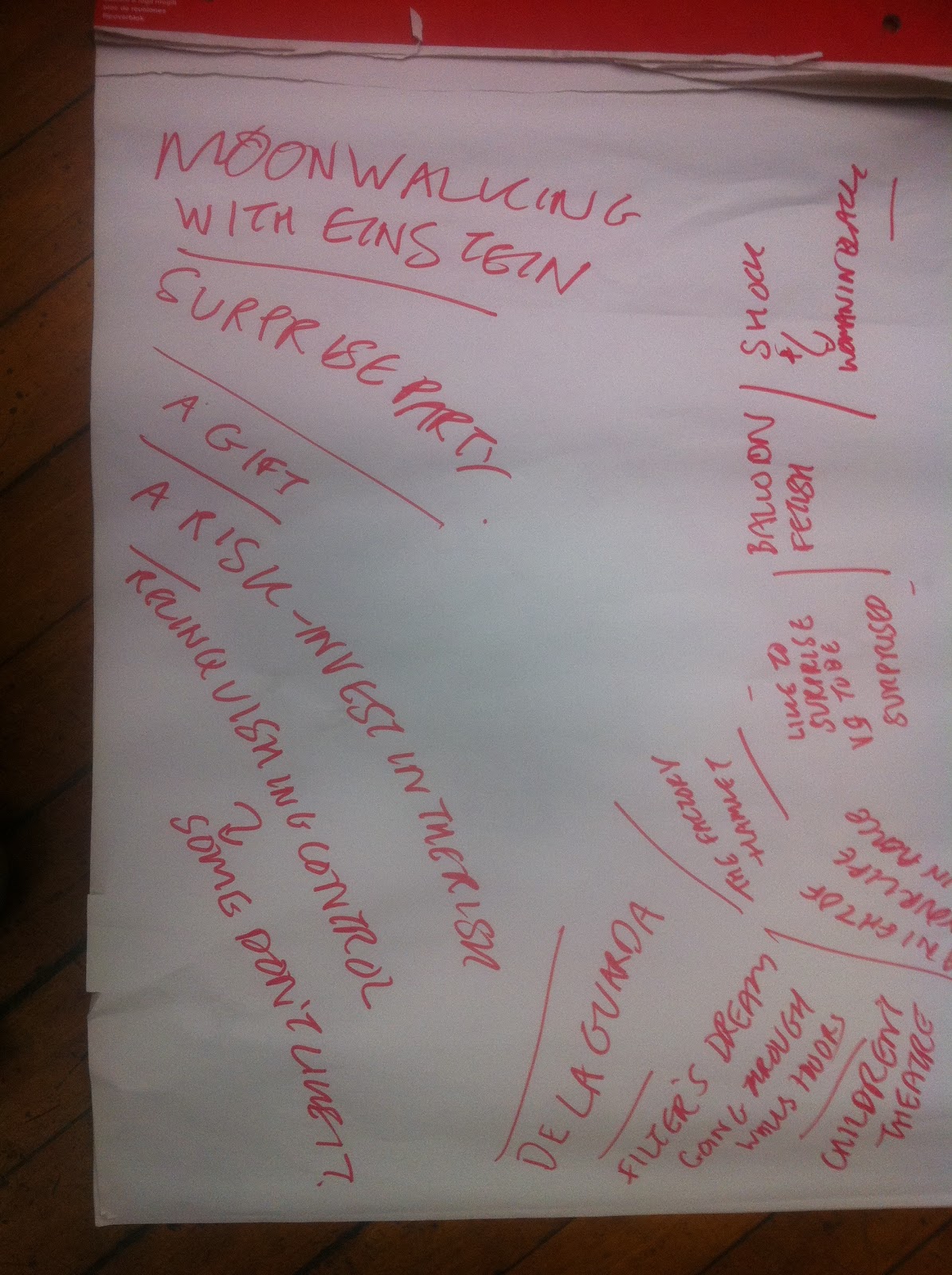


About 40 minutes in, I sensed that we might start flagging so I offered part 2 or to continue with part 1. Everyone wanted part 2. So I asked everyone if they liked to follow me out of York Hall. This was the only part I'd planned. I was surprised by how our departure itself became an event to everyone else in the room, and some people got up and joined the train.

I stopped outside the Hall to remind people that we might go some way and so it would be more difficult to use their two feet to go to another group if they got bored. I meant to stop at least one more time to give the same reminder but forgot. We walked left down Old Ford Road and turned towards The Approach. As we turned the corner, a man was quite brazenly pissing against a lamppost. A little further down, a cat posed on a purple wheelie-bin. I think it would have been popular if we'd gone to the pub but I had Victoria Park in mind, until a friend wished we weren't going to the park. A church hall suddenly presented itself at that moment so we walked into the yard and stopped.


Here was Part 3. We talked about what we wanted to do now to make it A Surprise, and what we'd tell people when we returned. We agreed to tell as much of the truth as possible and to let people imagine what else we might have done, rather than trying to manipulate too much. It was a very lovely discussion.

We did do something else too, but we agreed that we wouldn't tell you that.

On the way back, I was at the back of the line. When I saw the middle of our group pass a phone box - which I'd recce'd on the hoof to get the number and noting that the glass was broken so you could hear it ring - then I made it ring. It was answered in a flash.

This was a delightful session, and my sincere thanks to everyone who took part.

Theatre snobbery. Should theatre exclusively do what only theatre can do?


Convener: ANDREW WHYMENT

Participants:
LOOTIE JOHANSEN-BIBBY
ELLIE GRIFFITHS
BEELI HILLMAN
MATT BURMAN
MATT TRUEMAN
CLIVE MOORE
SAM PALLY
GREG MCCLAREN
EMMA BERNARD
DAN COPELAND

Summary of discussion, conclusions and/or recommendations:

We discussed the value of West End theatre. Some feel that it is art created for the wrong reasons; producer-led. Some feel that it is doing exactly what more theatre should do; engaging audiences in a way that makes people see theatre in the same light as music or football.

Taking theatre to the party- theatre and celebration


Convener: Roses Urquhart: www.rosesurquhart.net

Participants: Malina Chabocka, Trish Parry, Holly Hardy, Mark Courtice, sorry to others, didn’t get your names.

Summary of discussion, conclusions and/or recommendations:

I’m interested in building bridges between classical theatre and the riotous energy of festivals.  How to channel the energy and sense of community raised in performance into celebration instead of letting it dissapate as everyone goes home.

The notes below are incomplete; the full report will be online.

We began by talking about performance in non-conventional spaces; clubs, cabaret etc.  Outdoor festivals where music, performance and other aspects- food/drink convene in a leading theme that creates a forum for celebration.  How community is created in this way.

It was mentioned that festival culture facilitates celebration because it gives the participant multiple options- they can spontaneously follow their gut- go dancing, chill out, watch a play.  They have already paid for their ticket, they can wander away if something doesn’t grab them.

Although some festivals, Latitude in particular, have made a great effort to incorporate theatre, the festival circuit in general is tough to work.  Festivals often only offer tickets and expenses, facilities are basic, performance standards may be fairly patchy as many people not from performance backgrounds fill performance roles in exchange for tickets.

Returning to ‘normal’ theatre spaces, in town, we talked about how celebration can be brought into performance.  Shows such as Punchdrunk’s Masque of the Red Death and Barbican’s Office Party created a real experience of celebration. A ‘wander in’ policy was mentioned; how people could be helped to feel that they could spontaneously enter a theatre in the way they might bimble into a tent.

- more to be added!

What does ‘Post-Internet’ theatre look like?


Convener: Susanna Davies-Crook

Participants: Anon. – at various stages included Tom Ross Williams, Tassos Stevens, Matt Trueman, Amy Letman, Hannah Nicklin and more

Summary of discussion, conclusions and/or recommendations:

How theatre and performance practices are changing in an emergent age of digital nativity.

How technology is used in theatre

What a ‘post-medium’ condition could equate to in theatre

How character is used

How narrative changes across networked experience

The fear of losing the site of the theatre or the durational performative experience

Changing forms

The importance of live experience

Can you have theatre if it is just one participant experiencing something through the screen

Short sharp bursts of theatre or experience as equivalent to short sharp bursts of information on the Internet

Questions of access to the net

Timelines

Bombardment of narratives and information that the internet allows and how this changes artistic and writing practices

The difference in experience and intention of maker and audience

Dries Verhoeven (sp?)

Tim Etchells

SMS spectacular

Blast Theory

Rythmss

Coney

“Rules of Play” – book

gaming as a way of accessing fragmented narrative devices and self-emergent or self-organising narratives

How can theatre expose the characteristics of the network or machine – ghost in the machine

Rosa Menkman – glitch

Psycho-digital

Real / not real

Matt Locke

Character vs Roleplay

User-journey access

Deborah Pearson  - narrative in the internet age

Not using tech as a bolt on but it being irrevocably intrinsic to the creation and presentation of the work

Orange Tree performance

Grabbing attention, shifting audience attentions, overwhelming them

What might be exciting about making work with/for museum visitors?


Convener:  Sarah Punshon

Participants: Ellis Kerkhoven, James Hadley, Joanne Hartley, Nathan Curry, Tiphaine, Mary Swan, Dodger Phillips, Roses Urquhurt, Sarah Corbett, Isabel Carr, Malwina Chabocka, Gary Horsman, and others…

Summary of discussion, conclusions and/or recommendations:

Quite a lot of specific projects mentioned / described:

Sarah Punshon’s Natural History Museum projects (forthcoming); Ellis Kerkhoven’s possible British Museum musical for children; Tangled Feet’s Croyden Clock Tower project (14-16 March); Sarah Corbett’s experiences working as an Explainer at the NHM and current experiences at Museum of London; Emily Chapstick’s workshops at various museums; Proteus Theatre’s current project at a living history museum; and many more.

Big questions & issues:

Museums often want to cordon off a corner, or put a show in an auditorium – controlled, much more manageable.  But why turn a bit of a museum into a theatre?  How might we make work in the gallery spaces?  How to deal with huge practical issues?

Interaction / overlap between Interpreters/Explainers and actors – what does each do best?  NB Money: museums often don’t have much.  Linked issue: volunteers often do a lot of interpretation.

International Museum Theatre Alliance – should we all join that and make it better?

Individual passions – engaging people with small stories, specificity.  Sharing a passion, live, in person, is incredibly engaging.

The Object is central.  Can we turn the objects into celebrities by putting them into a show?  Objects have been touched by the living – who, why?  When we touch them now, what do we do with them?  Investigate!

Museums finding it hard to trust / understand artistic / theatrical approaches.  An artistic project unlikely to connect with everyone – museums v worried – want everything to be accessible to everyone.

The power of the curator: expert knowledge is what’s valued – temples of expertise.  Is it only valuable if it gets across “facts”?  Many (most?) visitors want factual content too.

Ownership.  Is a visitor’s interpretation as valid as the expert’s?  If a kid in Investigate at the NHM examines a bone and decides it’s from an elephant, and actually it’s from a fish, is that valid?  Do we need to ‘correct’ them?

What about fakes?  The Museum of Jurassic Technology – a fake museum, curated by a man taking it completely seriously. Or Movieplex by Nutkhut – a fake museum about a man who never existed. 

An experience like “The Unbelievable Truth” – a red herring in each gallery room – find the “fact” that’s actually wrong. 

Capturing the imagination: unexpected enhancements of emotional reactions.  Cabinets of wonders.  Power of the imagination: Night at the Museum surely influential in so many London museums now having sleepovers and lates.  Ditto Doctor Who – capture imagination and we want to find out facts.

What do visitors come to the museum feeling passionate about already?  Example of elderly museum visitors to a 1950s reconstruction, putting a gramophone record on and dancing.  How to encourage more of this?  How to document this?

Invisible theatre: performers as visitors, commenting loudly on all objects, playing with ignorance – gathering a following.

What about visitors as performers?  Moving through spaces – eg Mike Nelson show at Tate, moving through “taxi waiting rooms” – apparently getting lost and ending up “backstage”.  Going to secret, backstage places would be really exciting in a museum!

Choices: most museums are too big to see all of – how can visitors choose an exciting route through a museum?  Adventures, discovery, track down an object that’s been part of a performance?

Bringing things to a museum – perhaps swapping it for something already there.  Geocache-ing.

Breathing life into things, creating an atmosphere – these are things theatre/actors are good at doing.

You Know More Show Tunes Than You Think You Do. Musical Theatre and Releasing Your Inner Jazz Hands


Convener:    Amy Ip

Participants:     Amy Ip and John Ward
 
Summary of discussion, conclusions and/or recommendations:

Is the term Musical a dirty word? The view seemed to be; yes if seen from an artistic viewpoint and no from a commercial viewpoint. And the word commercial also seemed to have a negative connotation but that is a different session in itself.

It was discussed that a lot of people say that they “hate” Musical Theatre but it is much more prevalent in day-to-day life without people knowing it. A classic example being football supporters singing Carousel.

Why are Musicals seen as having lesser artistic merit when they require as much if not more work input as most pieces have to be rehearsed three times, from a music, acting and dance perspective?

There seems to have been a decline in new British Musical Theatre output in recent years and even venues such as Southwark Playhouse and The Union which do have musicals as part of their programming, only really put on tried and tested American musicals. The Bridewell used to provide a platform for new musical theatre writing but nothing seems to have taken its place.

John is currently working on an adaptation of Faust, to be shown at the Brighton Fringe and then London, which is a piece with songs and he is deciding whether it should be called a musical as the term has its benefits and drawbacks. The producer he has been working with was not keen to use the term musical due to the supposed audience that it would draw and also worried about how the piece would be viewed.

Science on Stage


Convener: Alex Lehman

Participants: Jacqueline Coombs, Jennifer Jackson, Roses Urquhart, Denise Stephenson, Sam smith, Zoe Cobb, Sian Rees, Sarah Pinshon, Angie Bual, Nicholas McInerny

Summary of discussion, conclusions and/or recommendations:

Basic Summary:

We talked about portraying scientific ideas without falling back on writing a biographical show about the scientist who discovered the idea.

Actual Notes:

TV show What Makes a Masterpiece, measuring neural responses of audience to art works. Possibility of using this in a live theatre piece.

Wellcome Trust have archive of past sponsored works on website.

Curious Directive

Gecko arts

One participant making a show about the sea heard about some marine biologists in Newcastle who want to work with artists.

Analogue do science shows

Discovery is the element that links theatre and science

Brian Eno’s opinion that attempts to combine science and art are often not very good  because artists and scientists are engaged in opposite processes – i.e. possibility vs. reality.

Barrier in working with scientists: artists says “what if” this happened and scientist says “but it wouldn’t”

Some scientists only see art as a vehicle for the science and not something in its own right.

Many scientists live in a university environment their whole lives and aren’t great at interfacing with people outside of it.

Oliver Sacks talks about neuroscientists who lack empathy skills

Andrew Dawson theatre lecture The Articulate Hand & work with people who have lost mobility in hands

Unlimited performance called Ethics of Progress, a lecture performance about science and morality

Personal opinion that Wellcome Trust work doesn’t really connect viscerally

An idea must be transcendent & poetic to become a work of art, which won’t happen if it stays grounded in facts

How do you create the feeling of wonder in the theatre space?

Partly it’s down to creator enthusiasm infecting the audience.

Science Fiction as an avenue

“Is it art’s job to communicate scientific ideas?”

Theatre & science as forms of storytelling.

Complicite’s A Disappearing Number as relating mathematical ideas to human narrative

Taking inspiration for structure. Super novae as inspiration for structure of a play.

Godhead @ Oval House is about faith and neurochemicals. Previous production, Kiss of Life, used Argon as a starting metaphor.

Is it possible to create theatre about something ‘other’ than human interests – the way that a painting or music can be? Or is theatre inextricably tied to human narratives?

One participant working on an immersive environment on a Wellcome grant – dealing with light and seasonal affectived disorder (SAD). Debate about whether an interactive environment is an ‘installation’ or ‘theatre’.

Fevered Sleep make scientific theatre shows

The devising process is itself a scientific process.

Atheism vs. religion debates are about the ‘why’ not the ‘what’ and theatre needs to be about the human ‘why’

Feuerbach

Engineering is creative and being too logical stunts engineering development just as much as in theatre.

Science and art used to be more linked

Idea that if you give a 5 year old a paperclip and ask him what he can do with it he’ll have thousands of ideas, but a 16 year old will only use it as a paperclip

Devising process – Darwin had mazes that he used to walk through to help his thinking.

Science itself is a form of theatre. Enjoyment of burning magnesium – bring that into space.

Make partnerships with scientists and people outside of theatre.

Artists and scientists share a certain form of arrogance.

Interactive performance where you ask the audience to become scientists, observing and measuring their worlds

Uncertainty principle can only be expressed in maths and trying to express it theatrically is impossible.

Use of movement rather than story. Blackwatch as a physical, non-narrative form that conveys the idea of patriotism.

Method of scientific inquiry – state of not knowing.

Narrative of process.

Neuroscientist flatmate sez: brain pats of creativity are directly linked to those for movement.

One participant doing PhD in neuroscience of musicians. Doubts that pathways are so specifically linked as above. More holistic.

Bonnie Bainbridge-Cohen. Body Mind Centering.

Relation between lower and upper brain in learning – you learn something by using whole upper brain, but once you’ve learned it is compressed and moves to lower brain.

Proposal of scientific theatre event where scientists give talks and artists share artistic responses to same ideas.

One participant working with mirror neurons in dance. Possibility of observing neurons of audience and performers during performance.

Using inspirations as mental filter – put on your ‘biology glasses’ as you go about your day if you want to make a show about biology.

Using forms from science as impro provocations.

Festival of the Spoken Nerd

Creative Learning as a job possibility – giving science shows to teach kids about science.

Night Kitchen Cabaret. Doing a show about comets – one character is a celestial mechanic working on comets. Comets being appropriated by government for use as missiles. Surreal cabaret show using science as inspiration.

Circus as a form of physics.

Dance piece about virus transmission.

Possible to physicalize entities and forces without anthropomorphizing them.

Tuesday, 28 February 2012

Audience Agency in ‘Political’ Theatre in Rehearsal and Performance


Conveners:
Tom Ross-Williams: (Populace theatre)
Becki Hillman: (In Good Company)

Participants: Tom Brocklehurst, John Ward, Susana Davis Cook, Rod Dixon, Christina Caralina, Nicola Sianhope, Fran Hyde, Eve Leigh, Lauren Cooney, Emma Callander…
 
Summary of discussion, conclusions and/or recommendations:

Questions/provocations/models of practice/thoughts relating to the group discussion:

-       come to me with a solution, not a problem
-       how do giving answers/asking questions lead to political agency in performance?
-       positivity/negativity for politicisation in performance
-       the efficacy of ownership/belonging for a theatre of action
-       Theatre Uncut and David Greig: his short play last year needing audience to participate – and empowering model? (Engendered emotional responses from audience members who empathised with what was going on and had to perform role-play)… …(but is an audience reading from a script in unison always empowering?)
-       Third Ring Out (performance) – educative, gaming model of performance, which began anonymously but became more involved/actively engaged
-       An invitation to become active/the active engagement of the audience must not lead to nowhere! (Where can it lead? – into other actions/networks/practices/social movements or groups? Into further productions? – how can we facilitate further engagement, what obstacles might we encounter as practitioners and how might we overcome them??)
-       Collective identity feels safer for an audience to practice agency (builds confidence). How can we engender this in rehearsal/performance? By splitting people into groups? Inviting them to socialise? Involving them in process……..
-       Is the word ‘political’ a turn off to theatre audiences (and what audiences do we want to politicize?) Is it unsexy/not escapist enough?...Automatically unpopular? Or is this relative to historical/political/economic contexts? Where is it sexy/popular? (Scotland? Other…?)
-       OR reclaim the word ‘political’???
-       Is being told something or being preached at always something we shy away from or do we accept it in contexts that aren’t ‘political’?
-       Is theatre encountering its biggest period of ‘formal explosion’?!


There’s much more but I am running out of time!....... thanks to tom and participants for great discussion! Becki


-       Donation  only political theatre
-       Don’t turn the lights out on the audience
-       Giving people a shared experience
-       But give audience a  role in political theatre is important
-       Leave a show feeling galvanised rather than  pacified
-       The power of obstruction – audience unified by having to solve a problem  of sharing a tight space
-       Encouraging audiences to be disobedient
-       Audience  - Soho Theatre  (manipulated  but disempowered?)
-       Nature of the offer given to the audience
o   If we are told what to think do we turn off?         
o   Demanding to share viewpoints  to incite reactionary thinking/action
-       Connect  audience to tangible  stories rather than abstract ideas
o   Like the demolition of local building
o   Localised is political theatre
-       We can learn from other forms – circus/stand-up/dance
-       7:84 Black Black Oil
-       What is your language
o   Political issue explored through a ceilidh
-       Shalom Baby – political  moment a gay kiss in Stratford East
-       “Be the change you want to see in the world”
Leave the theatre with the world “yes!”

Is Outdoor Theatre Indoor Theatres poor relation


Convener: Nathan Curry

A list of things that happened: Didn’t catch them?

Summary of discussion, conclusions and/or recommendations:

A list of things that happened:

What does outdoor theatre mean? Does it have to be free?
Does outdoor theatre need legitimacy? Who from? Why?
Is it about criticism? Why doesn’t outdoor theatre get reviewed?
Is everyone obsessed with bums on seats?
How do we value outdoor theatre? How does the public value outdoor theatre?
Does outdoor theatre lack the resources that indoor theatre has?
If it’s free do people value it?
How do we get people see outdoor work? Is it about marketing? Articulating value?
Is Watch this Space at The National Theatre just set dressing? Or is it intrinsic to their programming?
Hard to get intimacy outdoors?
We love the fact audiences can leave when they want
How do we tell stories outside?
Are we allowed to artistically fail outside? Scratch performances for the outdoors?
How do we trial things outside?
Possibility for R and D – Without Walls
Bureau of Silly Ideas have arches in Brixton as possible creative space for outdoor ideas
Outdoor theatre is more sustainable – it doesn’t need lights (mostly)
London Bubble mentioned as interesting outdoor company working with communities
How do we involve communities more in outdoor work?
By putting art in art galleries does it comodify it?
Does outdoor theatre have a national profile?
What can social networking do?
How can we value the creative economy of outdoor theatre?
Financial vs happiness? How do we measure outdoor theatre?
Why do programmers, programme work?
Is it local authorities role to programme outdoor work?
How do we raise standard of outdoor theatre?
Do people only book tried and tested work?
Is outdoor theatre really about the community and use of public space? (Examples of Passion in Port Talbot.)
There are multiple access points for outdoor theatre
The beauty of outdoor work is unexpected events – inside of theatres the unexpected event is designed to never happen!
Can outdoor theatre be more serious? Political? Why does it always rely on comedic entertainment?
Its ok to be distracted when watching outside – its NOT inside of theatres.